
A Complete Beginner’s Guide
Table of Contents
1. What Is Auto Insurance, Exactly?
2. How Does Auto Insurance Work?
3. The 6 Main Types of Coverage Explained
4. Key Terms Every Driver Must Know
5. How Much Does Auto Insurance Cost?
6. What Affects Your Premium?
7. Is Auto Insurance Required by Law?
8. How to Choose the Right Policy
9. Frequently Asked Questions (FAQ) 10. Related Guides on InsureItGuide.com
What Is Auto Insurance, Exactly?
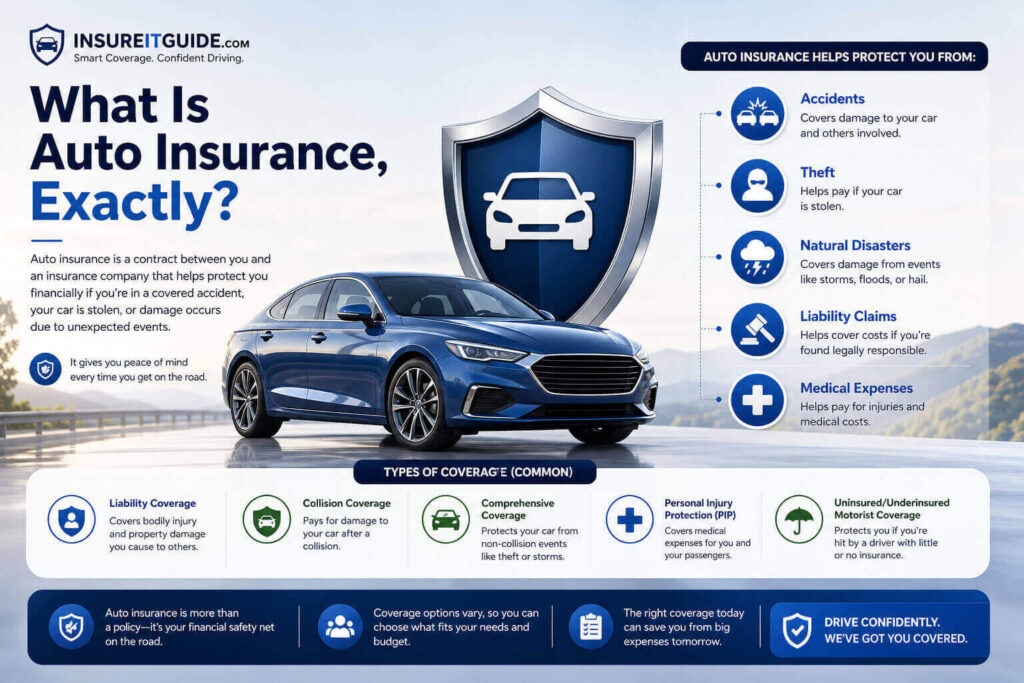
Let’s start at the very beginning. Auto insurance, also called car insurance, is a financial agreement between you and an insurance company. You make a regular payment called a premium, and the insurance company agrees to help cover the cost of specific financial losses related to your vehicle.
Think of it this way: a car accident can cost anywhere from a few thousand dollars to several hundred thousand dollars, especially if someone is seriously injured. Very few people have that kind of money sitting in a bank account. Auto insurance is the safety net that prevents one bad day on the road from destroying your finances for years.
| 💡 Key Term: AUTO INSURANCE Auto insurance = you pay a monthly or semi-annual fee (the premium). In return, your insurance company pays for certain losses if something bad happens involving your car: accidents, theft, weather damage, and more. It is a legally binding contract called a policy. |
| 📍 Real Example: Sarah pays $140 per month for car insurance. One afternoon, she rear-ends another vehicle at a stoplight. The damage to the other car is $6,200, and the other driver needs $4,000 in medical treatment. Without insurance, Sarah owes $10,200 out of her own pocket. With her policy, she pays her $500 deductible, and her insurer covers the remaining $9,700. That monthly $140 just saved her nearly $10,000. |
How Does Auto Insurance Work in the USA?
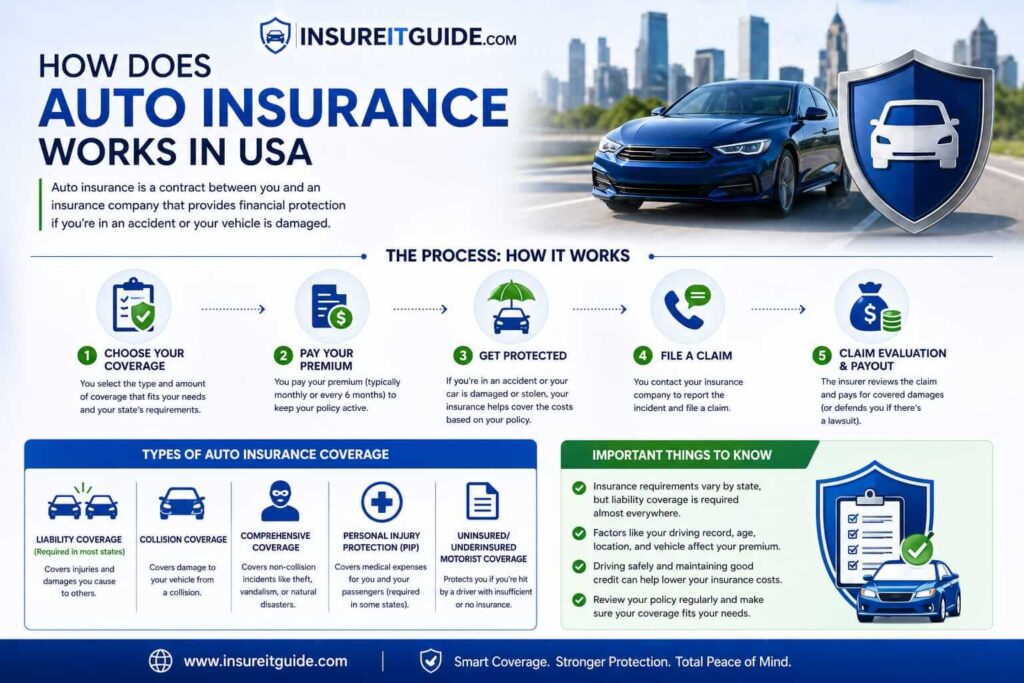
Auto insurance runs on a principle called risk pooling. Thousands of drivers all pay into an insurance company. Most of them will not have a major accident this year. The money collected from everyone pays the claims of the few who do. You are essentially sharing risk with millions of other drivers nationwide.
The process flows through five clear steps from purchase to payout:
- Buy a policy. You choose an insurance company, the coverage types, and the amounts you want. You agree to pay a monthly or semi-annual premium. The insurer issues a policy document and proof-of-insurance card.
- A Covered Event Happens. You are in an accident, your car is stolen, a hailstorm damages it, or another covered event occurs. This is called a covered loss.
- You File a Claim. You contact your insurance company to report the incident. The insurer assigns a claims adjuster to review the situation and assess the damages.
- You Pay Your Deductible. If the claim is approved, you pay your agreed deductible first: for example, $500 or $1,000. Your insurer then pays the remaining covered costs up to your policy limits.
- The Insurer Pays. The insurance company pays the repair shop, medical provider, or the other party’s insurer directly or sends you a payment check.
The 6 Main Types of Auto Insurance Coverage
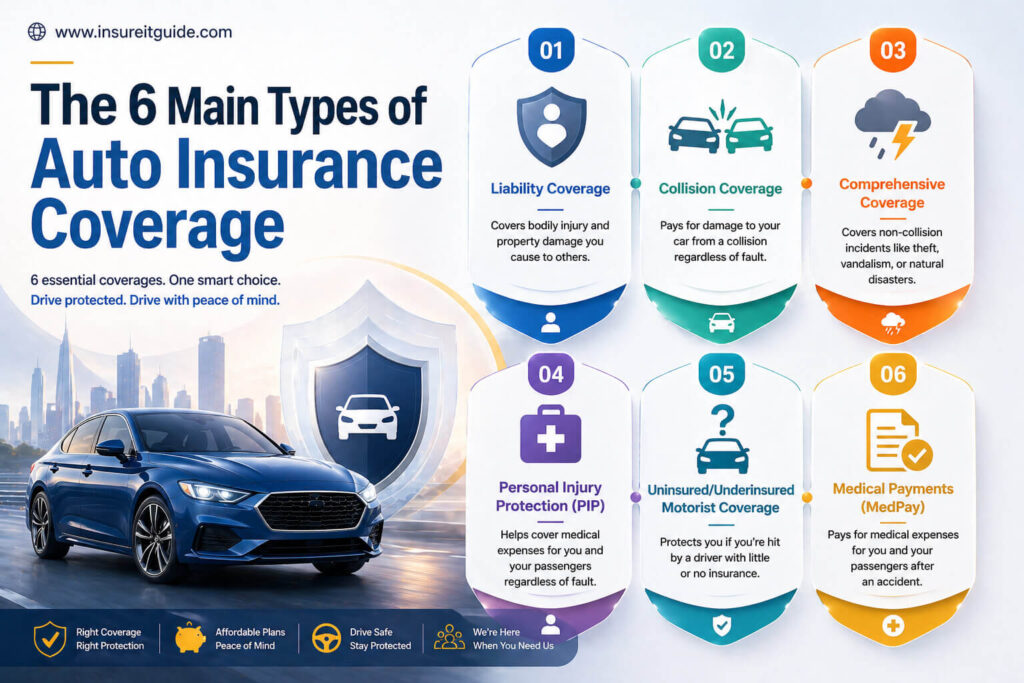
Auto insurance is not a single product. It is a combination of different coverage types you can mix and match. Understanding each one is essential before you buy any policy. Here are the six most important types every American driver needs to know.
| Coverage Type | What It Covers | Avg. Monthly | Required? |
| Liability Insurance | Damage/injuries you cause to others | $30-$80/mo | Yes (most states) |
| Collision Coverage | Repairs YOUR car after a crash (any fault) | $50-$100/mo | If car is financed |
| Comprehensive Coverage | Theft, fire, flood, hail, vandalism | $15-$40/mo | If car is financed |
| Personal Injury Protection | YOUR medical bills and lost wages, any fault | $10-$30/mo | No-fault states |
| Uninsured Motorist (UM/UIM) | Protects you when at-fault driver has no insurance | $8-$20/mo | Some states |
| Roadside Assistance | Towing, flat tires, dead battery, lockout | $3-$8/mo | No (optional) |
Liability Insurance: The One You Cannot Skip
Liability insurance is legally required in almost every US state. It pays for damage and injuries you cause to other people and their property when you are at fault in an accident. It does not pay for your own car or your own injuries. Liability coverage appears as three numbers, for example, 100/300/100, which means the following:
- $100,000 maximum for bodily injury per person you injure
- $300,000 maximum total for all injuries in a single accident
- $100,000 maximum for property damage you cause
Collision Coverage: For Your Own Car After a Crash
Collision coverage pays to repair or replace your own vehicle after a collision, regardless of who caused the accident. This includes crashing into another car, hitting a tree, or rolling your vehicle. If your car is financed or leased, your lender requires this coverage.
Comprehensive Coverage: For Non-Crash Damage
Comprehensive coverage pays for damage to your car that is not caused by a collision. This includes theft, fire, flooding, hail damage, vandalism, hitting a deer, and falling objects. Think of it as the “everything except a crash” policy. It is especially valuable in areas prone to severe weather.
| ⚠️ “Full Coverage” Is Not an Official Policy Type. You will often hear people say they have “full coverage.” This is informal shorthand for a policy that includes liability plus collision plus comprehensive insurance together. Always ask your insurer exactly which coverages are included in your policy and at what limits. |
Personal Injury Protection (PIP): Your Medical Bills First
PIP covers your own medical bills and lost wages after an accident, regardless of who was at fault. It is required in no-fault states like Florida, New York, Michigan, and New Jersey. In those states, your own insurer pays your medical bills first, up to your PIP limit, before fault is even determined.
Uninsured Motorist Coverage: When the Other Driver Has Nothing
About 1 in 8 American drivers is currently uninsured. If one of them hits you, there is no insurance on their side to pay your bills. Uninsured Motorist (UM) coverage steps in and pays your damages when the at-fault driver has no insurance or has limits too low to cover your losses. That second scenario is called underinsured motorist coverage, or UIM.
Auto Insurance Key Terms Every Driver Must Know
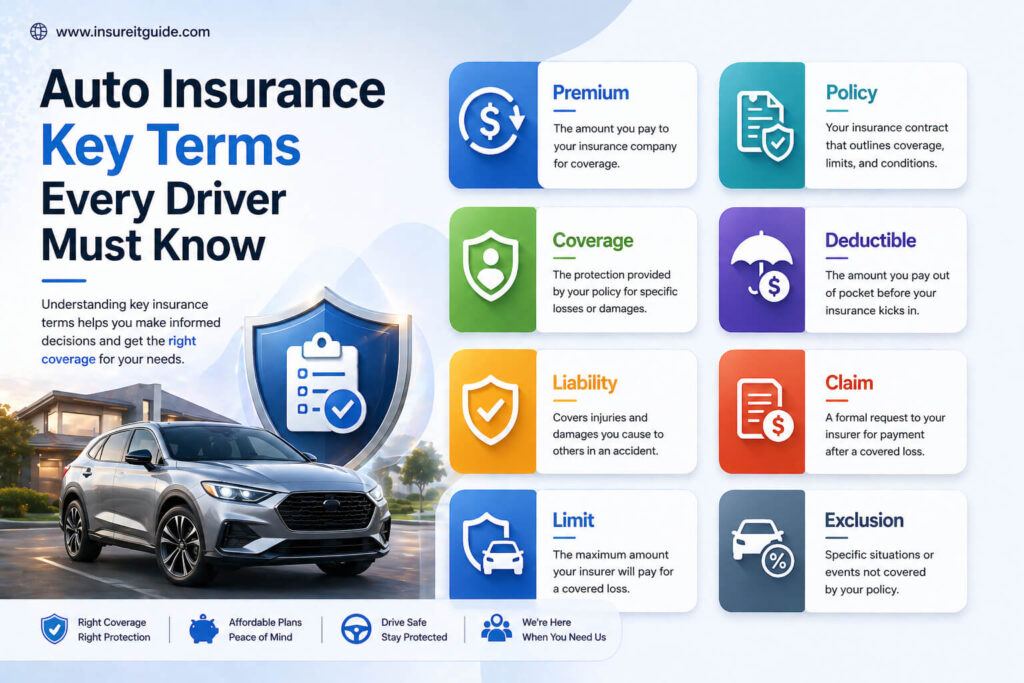
Insurance has its own vocabulary. Here are the most important terms, explained in plain English with real dollar examples.
Premium
The premium is the amount you pay to keep your insurance active, usually billed monthly or every six months. The national average for full coverage is around $167 per month as of 2025. Your premium is set by your age, driving history, location, vehicle, and the coverage levels you choose.
| 💡 Key Term: PREMIUM Your premium is what you pay regularly to keep your coverage active. Think of it as a monthly membership fee. Stop paying and your coverage lapses immediately. |
Deductible
The deductible is the amount you pay out of your own pocket when you file a claim, before your insurance pays the rest. You choose this when you buy your policy. Common amounts are $250, $500, or $1,000. Here is how the same $3,200 repair bill plays out at each level:
| Your Deductible | You pay. | Insurer Pays | Total Damage |
| $250 deductible | $250 | $2,950 | $3,200 |
| $500 deductible | $500 | $2,700 | $3,200 |
| $1,000 deductible | $1,000 | $2,200 | $3,200 |
| 💰 A higher deductible = a lower monthly premium but more out-of-pocket when you claim. Lower deductible = higher monthly premium, but less to pay when something happens. Choose a deductible you could realistically cover in an emergency. |
Coverage Limit
A coverage limit is the maximum dollar amount your insurance will pay for a covered claim. If your property damage liability limit is $50,000 and you cause $80,000 in damage, you personally owe the remaining $30,000. This is why insurance professionals always recommend buying limits higher than your state’s legal minimum.
Policy Period
Most auto insurance policies run for either six months or twelve months before renewal. Your insurer reviews your driving record and claims history at each renewal and may adjust your premium up or down accordingly.
Exclusion
An exclusion is a situation or event that your policy specifically does not cover. Most personal auto policies, for example, exclude coverage when you drive for a rideshare app like Uber or Lyft. Always read the exclusions section of your policy so there are no surprises after an accident.
How Much Does Auto Insurance Cost?
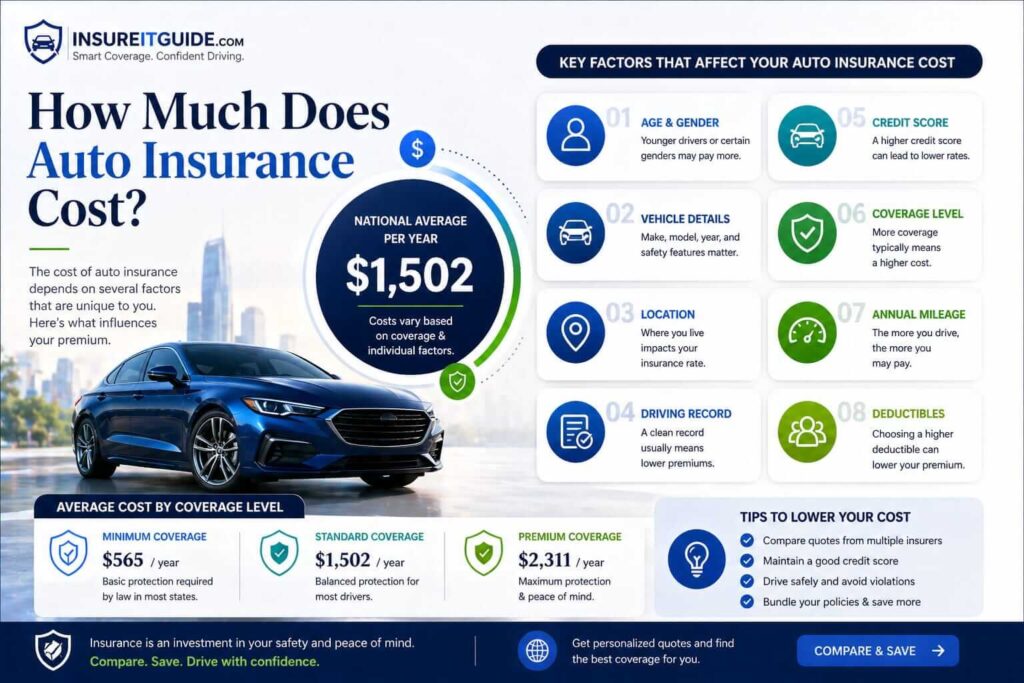
Here is what American drivers actually pay for auto insurance in 2025. These are national averages. Your personal rate may be higher or lower depending on your profile, your state, and the insurer you choose.
| Coverage Level | Avg. Monthly | Avg. Annual | What’s Covered |
| Liability Only (State Minimum) | $62/month | $744/year | Other people only |
| Liability + Collision | $115/month | $1,380/year | Others + your car in accidents |
| Full Coverage (Liability + Collision + Comprehensive) | $167/month | $2,008/year | Most complete everyday protection |
| High-Risk Driver (DUI/Major Violations) | $280-$420/mo | $3,360-$5,040/yr | Varies by risk profile |
| Real-World Example: Marcus, 32, Dallas, TX. Clean record. Good credit. 2021 Honda Accord. 12,000 miles/year. Liability (100/300/100 limits) $68/month Collision ($500 deductible) $74/month Comprehensive ($250 deductible) $18/month Uninsured motorist coverage: $12/month Roadside Assistance add-on: $4/month. TOTAL: $176/month ($2,112/year). If Marcus raises both deductibles to $1,000, he saves approximately $38/month ($456/year). That trade-off makes sense only if he has $1,000 ready in savings. |
What Affects Your Auto Insurance Premium?
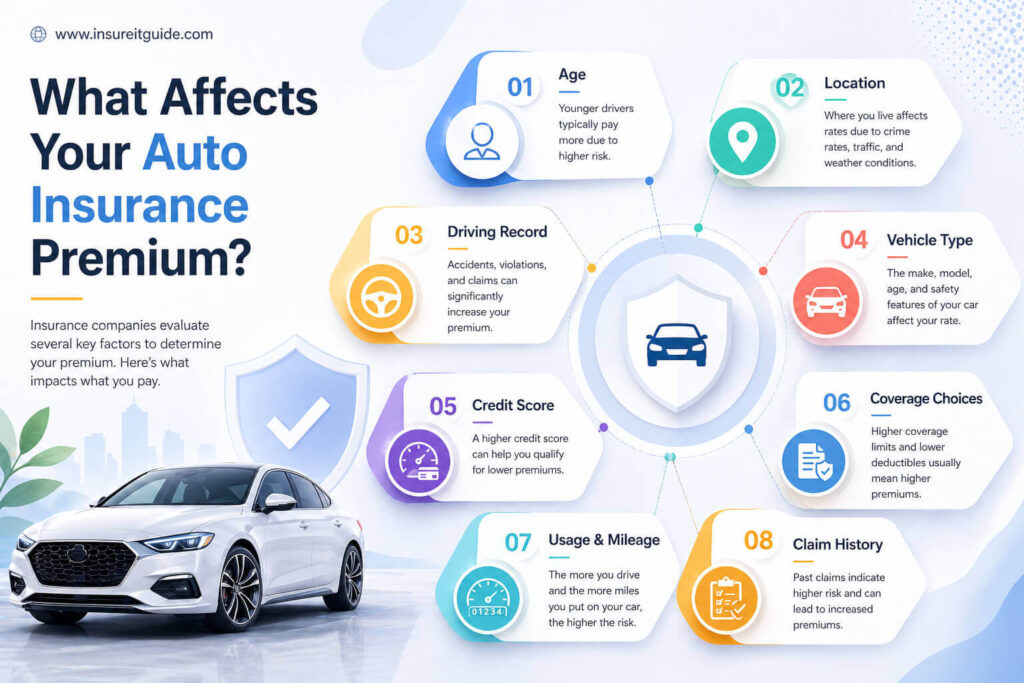
Insurance companies do not set your rate randomly. They use a detailed risk profile to calculate what you are likely to cost them. These eight factors carry the most weight:
- Driving history. Accidents and traffic violations raise your rate significantly. A clean record for three or more years earns discounts of 10 to 30%. A single at-fault accident can raise your premium by 40% or more.
- Age. Drivers under 25 pay the most. Teenage drivers may pay $3,000 to $5,000 per year. Rates drop substantially after 25 and again after 30 with a clean record.
- Location. Urban drivers pay more than rural drivers due to higher accident rates, theft rates, and population density. Michigan, Louisiana, and Florida consistently rank as the most expensive states.
- Vehicle type. Luxury cars, sports cars, and some electric vehicles cost more to insure due to higher repair and replacement costs. Safe, practical vehicles like the Honda CR-V or Toyota Camry typically carry lower rates.
- Credit score. In most US states, insurers use your credit history to help set your premium. Better credit generally means a lower rate. California, Hawaii, and Massachusetts prohibit this practice by law.
- Annual mileage. Drivers who log fewer than 7,500 miles per year qualify for low-mileage discounts of 5 to 15%. Usage-based programs like Progressive Snapshot track your actual habits and can offer larger savings.
- Coverage levels and deductibles. More coverage and lower deductibles equal a higher premium. Adjusting these is the most direct way to control your monthly cost, but always balance savings against the financial risk you take on.
- Marital status. Married drivers statistically file fewer claims. In most states, married drivers pay 4 to 8% less than single drivers with otherwise identical profiles.
Is Auto Insurance Required by Law in the US?
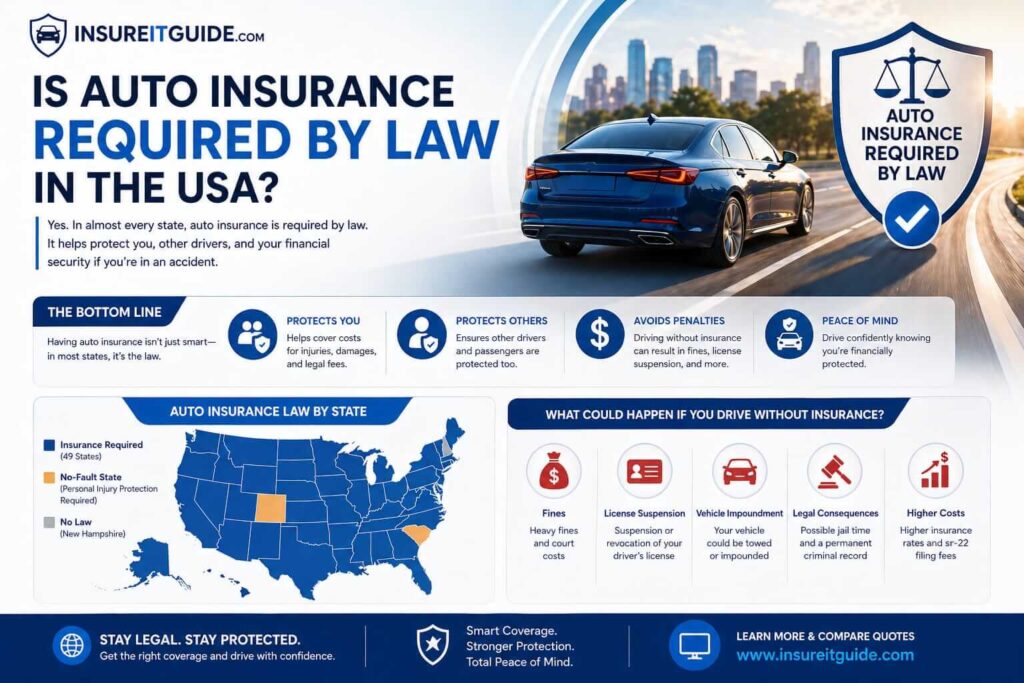
Yes, in almost every state. All US states except New Hampshire require drivers to carry at least minimum liability insurance. New Hampshire requires you to demonstrate financial responsibility, meaning you must prove you can pay for damages without insurance. In practice, the vast majority of New Hampshire drivers still carry a policy.
State minimum requirements appear as three numbers. If your state requires 25/50/25, that means:
- $25,000 maximum payout for bodily injury per person injured
- $50,000 maximum total payout for all injuries in a single accident
- $25,000 maximum payout for property damage you cause
| ⚠️ State minimums are usually not enough. A single serious injury accident, with broken bones, surgery, and hospitalization, can easily top $100,000 in medical bills alone. Most insurance professionals recommend 100/300/100 limits or higher for meaningful financial protection. |
Penalties for driving without insurance include fines from $100 to $5,000 or more, driver’s license suspension, vehicle impoundment, SR-22 filing requirements that sharply raise future premiums, and full personal liability for all accident damages with no coverage to absorb the cost.
How to Choose the Right Auto Insurance Policy
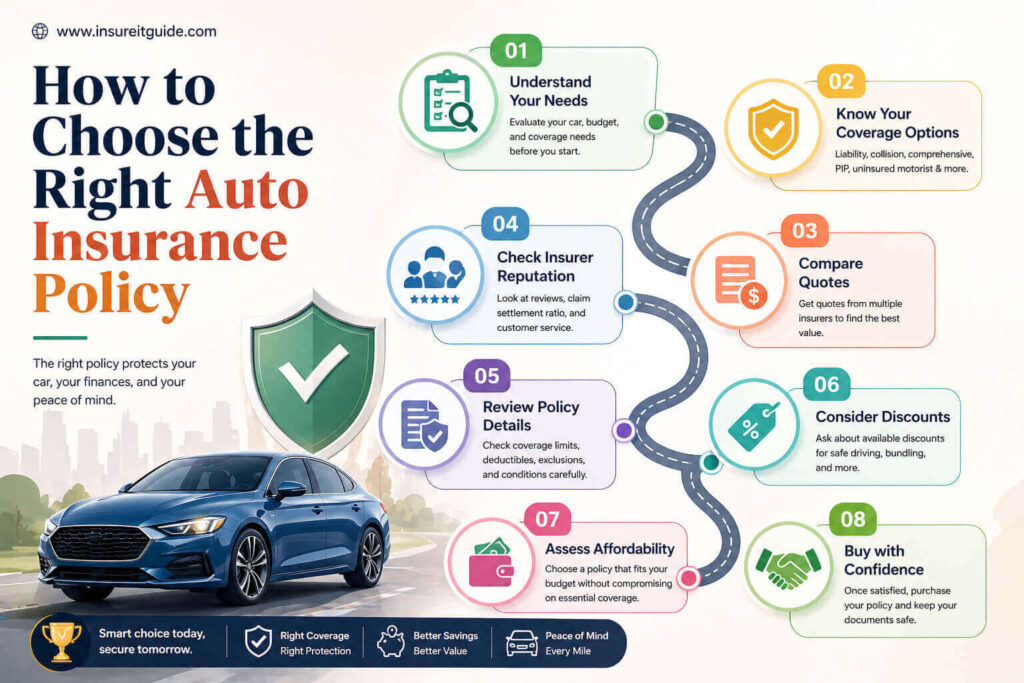
With hundreds of insurers and thousands of possible coverage combinations, picking a policy can feel overwhelming. These five steps cut through the noise:
Know your state’s minimum requirements
Look up your state’s minimum liability limits first. This is your legal floor, not your recommended ceiling. Meet the minimum, then decide how much additional protection you actually need.
Assess your vehicle’s value
If your car is worth less than $4,000, paying for collision and comprehensive may not make financial sense. The premiums could cost more over time than the insurance would pay in a total loss. If your car is financed or leased, your lender requires full coverage regardless.
Choose a deductible you can genuinely afford
A $1,000 deductible lowers your premium but means you need $1,000 available when you file a claim. If a $1,000 emergency would seriously strain your finances, choose $500 or $250 instead.
Get at least three quotes and compare them properly
The same driver with the same car can receive quotes ranging from $90 to $220 per month from different insurers. Use comparison sites like The Zebra or Insurify, but also check directly with USAA (military families), Erie Insurance, and regional carriers in your state. Always compare identical coverage levels, not just prices.
Ask about every available discount
Most insurers offer savings for safe driving history, bundling home and auto (10 to 25% off), good student discounts, low mileage, paperless billing, paying in full upfront (3 to 5% off), and new vehicles with advanced safety features. Ask specifically what you qualify for.
| 💰 Pro Tip: When Shopping, Compare Coverage—Not Just Price. The cheapest policy is not always the best deal. A policy that costs $20/month less but carries $10,000 lower liability limits could expose you to $30,000 or more out of pocket after a serious accident. Line up identical coverage levels side by side when comparing quotes. Consider working with an independent insurance agent who shops multiple insurers on your behalf at no cost to you. |
The Bottom Line
Auto insurance is not just a legal requirement in nearly every US state. It is one of the most important financial protections you can have as a driver. Without it, a single accident can result in tens or even hundreds of thousands of dollars in personal liability.
Start by understanding the six core coverage types and learning the key terms: premium, deductible, and coverage limit. Then compare at least three quotes before buying. The right policy balances the coverage you need with a premium you can comfortably afford every month.
| 🔗 Questions? Every topic on InsureItGuide.com is explained in plain English, with real dollar examples and zero jargon. Explore the related guides listed in Section 10 below. |
Frequently Asked Questions (FAQ
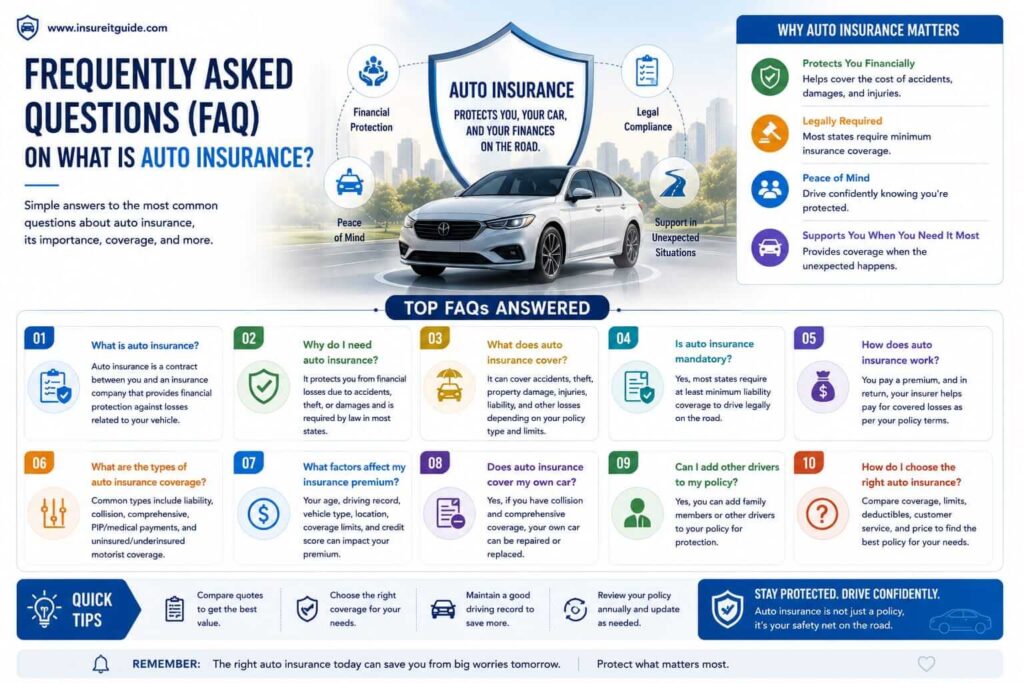
These are the most commonly searched questions about auto insurance by Americans learning the basics. Each answer is written for featured snippet targeting.
Q: What is auto insurance in simple terms?
A: Auto insurance is a contract between you and an insurance company. You pay a regular fee called a premium, and in return the company agrees to pay for covered financial losses if you are in a car accident, your car is stolen, or another covered event happens. It protects you from having to pay potentially devastating costs entirely out of your own pocket.
Q: Is auto insurance required by law in the US?
A: Yes. Almost every US state requires drivers to carry at least minimum liability insurance. The only exception is New Hampshire, where you must prove you can cover damages financially without a policy. Driving without required insurance can result in fines from $100 to $5,000 or more, license suspension, vehicle impoundment, and full personal liability for all accident damages.
Q: How much does auto insurance cost per month?
A: The national average for full coverage auto insurance is approximately $167 per month ($2,008 per year) as of 2025. Minimum liability-only coverage averages around $62 per month. Your actual cost depends on your age, driving history, location, vehicle type, and the coverage levels you select.
Q: What is a deductible in auto insurance?
A: A deductible is the amount you pay out of your own pocket before your insurance pays the rest of a covered claim. For example, if you have a $500 deductible and your repair bill is $3,200, you pay $500 and your insurer pays $2,700. Choosing a higher deductible lowers your monthly premium; a lower deductible raises it.
Q: What is the difference between liability and full coverage?
A: Liability insurance pays only for damage and injuries you cause to other people and their property. It does not cover your own car or your own injuries. ‘Full coverage’ is not an official policy type. It is informal shorthand for a combination of liability, collision, and comprehensive insurance, which together protect both other people and your own vehicle.
Q: What is the difference between collision and comprehensive coverage?
A: Collision coverage pays for repairs to your own car after it hits something: another vehicle, a guardrail, or a tree. Comprehensive coverage pays for non-collision damage, such as theft, fire, flooding, hail, vandalism, or striking an animal. Together, they form what most drivers call full coverage.
Q: Does auto insurance cover a rental car?
A: It depends on your policy. Some policies include rental reimbursement coverage, typically $3 to $8 per month extra, which pays for a rental car while your vehicle is being repaired after a covered claim. Without this add-on, you pay for the rental yourself. For personal travel rentals, your auto policy may offer some coverage. Always confirm with your insurer before renting.
Q: How do I choose the right auto insurance coverage?
A: Start by meeting your state’s minimum liability requirements. Then ask, “Is your car financed or leased?” (Full coverage required by lender.) Can you handle a $1,000 emergency? (If not, choose a lower deductible.) Do you drive in high-traffic areas? (Consider higher liability limits.) Get at least three quotes and compare identical coverage levels, not just prices.
Q: What happens if someone else drives my car and gets in an accident?
A: In most cases, auto insurance follows the car, not the driver. If you give someone permission to drive your car and they cause an accident, your insurance policy is typically the primary coverage that pays, not the driver’s own policy. Only lend your car to trusted drivers and make sure your coverage limits are adequate.
Q: Can I get auto insurance with a bad driving record?
A: Yes, but expect to pay significantly more. Drivers with DUIs, multiple at-fault accidents, or serious violations are considered high-risk and typically pay $280 to $420 or more per month. You may need to file an SR-22 certificate. Some state-run assigned risk programs ensure minimum coverage is always available even if standard insurers decline you.
Continue Learning: Related Guides on InsureItGuide.com
Now that you understand the basics, explore these related guides to build your knowledge further. Add the live links once each article is published.
- How Much Does Car Insurance Cost? A Complete US Pricing Guide (2025) — www.insureitguide.com/how-much-is-car-insurance/
- 17 Proven Ways to Lower Your Car Insurance Premium Right www.insureitguide.com/how-to-lower-car-insurance/
- Auto Insurance Claim Denied? 10 Reasons and How to Fight www.insureitguide.com/auto-insurance-claim-denied/
Disclaimer
The information on InsureItGuide.com is for educational purposes only and does not constitute legal or financial advice. Insurance rates, coverage requirements, and regulations vary by state and change over time. Always consult a licensed insurance professional or your state’s Department of Insurance for advice specific to your personal situation.
— InsureItGuide.com | Real Advice. Real Savings. —
