
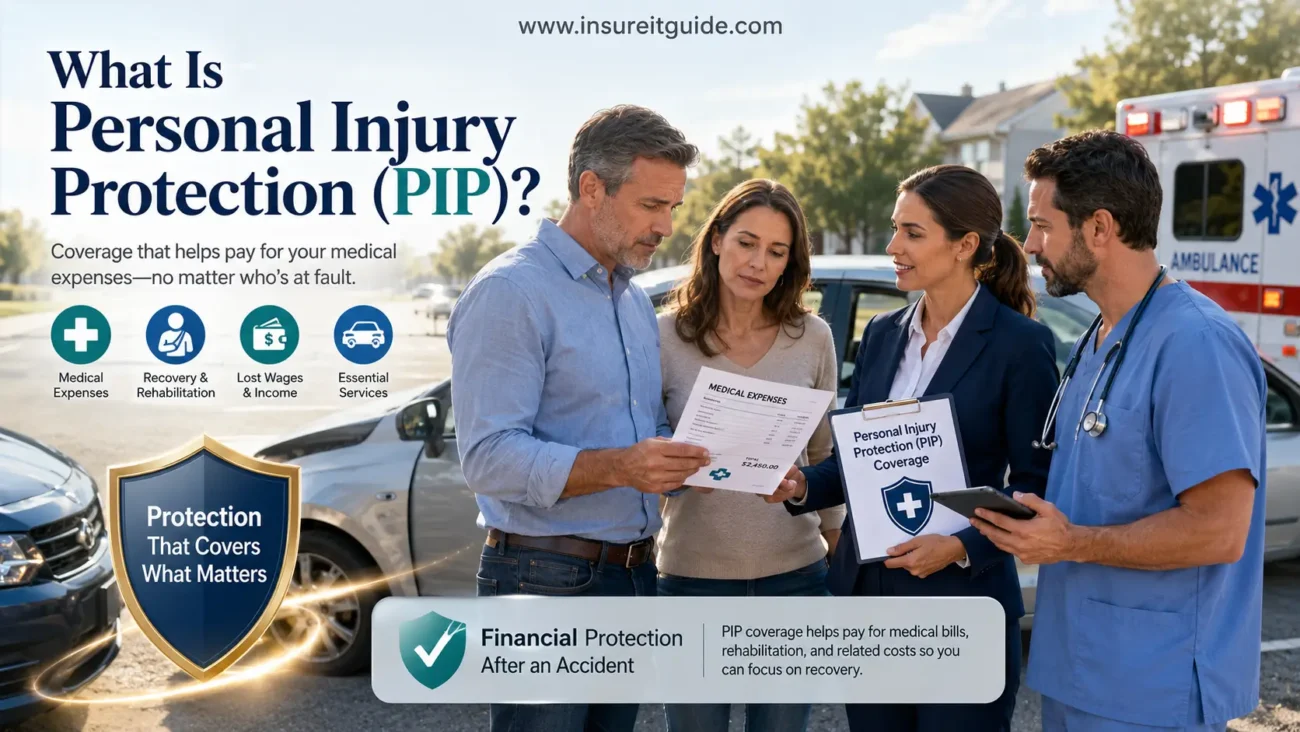
A car accident can affect far more than your vehicle. Medical bills, lost income, rehabilitation expenses, and the inability to perform everyday tasks can create enormous financial stress during an already difficult time. This is where Personal Injury Protection (PIP) coverage becomes valuable.
If you’ve ever asked yourself, “What is Personal Injury Protection in car insurance?”, you’re not alone. Many drivers purchase auto insurance policies without fully understanding how PIP works, what expenses it covers, or whether it is required in their state.
Simply put, Personal Injury Protection (PIP) is a type of auto insurance coverage that helps pay for medical expenses and certain related costs resulting from a car accident, regardless of who caused the accident.
In states with no-fault insurance systems, PIP serves as an important financial safety net by allowing injured individuals to receive benefits quickly without waiting for fault investigations or legal disputes.
Whether you’re a first-time driver, a parent reviewing family insurance needs, or someone trying to understand your existing policy, this guide explains everything you need to know about PIP insurance coverage, including what it covers, what it excludes, and whether it deserves a place in your insurance portfolio.
Table of Contents
- What Is Personal Injury Protection (PIP)?
- How Does PIP Insurance Work?
- What Does PIP Insurance Cover?
- What Is Not Covered by PIP?
- PIP vs Medical Payments Coverage (MedPay)
- PIP vs Bodily Injury Liability Insurance
- Which States Require PIP Coverage?
- How Much PIP Coverage Do You Need?
- How Personal Injury Protection Deductibles Work
- How the PIP Insurance Claim Process Works
- Real-Life Financial Scenarios: Why PIP Matters
- Is Personal Injury Protection Worth It?
- Common Myths About PIP Insurance
- Frequently Asked Questions
- Key Takeaways
- Conclusion
What Is Personal Injury Protection (PIP)?
Personal Injury Protection (PIP) insurance is a type of auto insurance coverage that helps pay for medical expenses and certain other accident-related costs for you and your passengers after a car accident, regardless of who caused the crash.
Unlike bodily injury liability insurance, which covers injuries suffered by other people when you are at fault, PIP focuses on protecting you, your household members, and your passengers. As a result, you can receive benefits more quickly without waiting for fault to be determined.
Because of this unique feature, many people refer to PIP as “no-fault insurance coverage.”
Why Was PIP Created?
The primary goals of PIP coverage are to:
- Provide quick access to medical treatment.
- Reduce lengthy disputes about fault.
- Speed up compensation for accident victims.
- Minimize lawsuits related to minor accidents.
- Help families cope with unexpected financial burdens.
Without PIP coverage, injured individuals may have to wait months for liability investigations and settlements to conclude. As a result, they could face delays in receiving reimbursement for essential medical expenses.
How Does PIP Insurance Work?
One of the biggest advantages of PIP coverage is its simplicity during stressful situations.
After a covered accident, you typically file a claim directly with your own insurance company, regardless of who caused the crash. The insurer then reviews your claim and determines which expenses qualify for coverage.
Once approved, the insurance company pays eligible expenses up to your policy limits. As a result, you can often receive benefits more quickly than you would through a traditional fault-based claim process.
Real-World Example
Imagine Emily is involved in a car accident on her way to work.
As a result of the accident, she suffers:
- A broken wrist
- Whiplash injuries
- Minor concussion symptoms
Her immediate expenses include:
| Expense | Cost |
| Ambulance Services | $900 |
| Emergency Room Visit | $2,100 |
| Diagnostic Imaging | $1,500 |
| Follow-Up Doctor Visits | $700 |
| Physical Therapy | $1,800 |
Total Medical Costs: $7,000
Since Emily carries PIP coverage with a sufficient policy limit, she files the claim through her own insurer and receives benefits regardless of fault.
This immediate access to financial assistance allows her to focus on recovery rather than worrying about medical bills.
What Does PIP Insurance Cover?
One of the most common questions consumers ask is:
“What does PIP insurance actually cover after an accident?”
Although coverage details vary by state and insurer, PIP generally covers several categories of expenses.
1. Medical Expenses
PIP primarily exists to cover necessary medical treatment resulting from accident-related injuries.
Covered expenses may include:
- Emergency room treatment
- Ambulance transportation
- Hospitalization
- Surgery
- Physician visits
- X-rays and MRI scans
- Prescription medications
- Rehabilitation services
- Physical therapy
- Occupational therapy
- Chiropractic treatment (where permitted)
Example:
Following an accident, Sarah requires six weeks of physical therapy costing $3,500.
Her PIP coverage helps pay these expenses, reducing her out-of-pocket burden.
2. Lost Wages
Serious injuries often prevent people from returning to work immediately.
Furthermore, many PIP policies provide compensation for a portion of lost income if accident-related injuries prevent you from working or performing your job duties.
Example:
John earns $1,200 per week.
After the accident, he misses four weeks of work while recovering from his injuries.
If his PIP policy includes wage-loss benefits, he may receive reimbursement for a portion of his lost income, subject to the policy limits. As a result, the financial impact of being unable to work may be reduced during the recovery period.
This feature can be especially valuable for:
- Self-employed individuals
- Sole household income earners
- Hourly employees
- Workers without disability benefits
3. Essential Services Coverage
Some injuries make routine household activities difficult or impossible.
PIP coverage may help pay for replacement services you need during recovery.
Examples include:
- Childcare expenses
- House cleaning services
- Yard maintenance
- Transportation assistance
- Grocery delivery services
These benefits are often overlooked but can significantly reduce stress for injured families.
4. Funeral and Burial Expenses
In tragic cases involving fatal injuries, PIP may help cover funeral and burial expenses.
However, these costs can quickly add up and create additional financial hardship for grieving families. For this reason, this coverage can provide valuable financial support during a difficult time.
Coverage limits vary significantly based on state laws and the terms of the policy.
5. Survivor Benefits
Certain states allow PIP coverage to provide ongoing financial assistance to surviving dependents following a fatal accident.
These benefits may help replace lost household income during a difficult transition period.
What Is Not Covered by PIP?
Although PIP provides broad financial protection, it does not cover every accident-related expense.
Generally, PIP does not cover:
- Vehicle repair costs
- Collision damage to your car
- Property damage caused to others
- Pain and suffering compensation
- Punitive damages
- Intentional injuries
- Non-approved treatments
- Injuries occurring during excluded activities
Understanding these exclusions helps prevent misunderstandings when filing claims.
Many drivers mistakenly assume PIP functions as comprehensive accident protection. In reality, it is designed specifically to address injury-related expenses.
PIP vs Medical Payments Coverage (MedPay)
Personal Injury Protection and Medical Payments Coverage (MedPay) are often confused because both help cover medical expenses after an accident.
However, important differences exist.
| Feature | PIP Insurance | MedPay |
| Medical Expenses | Yes | Yes |
| Lost Wages | Usually Yes | No |
| Essential Services | Often Yes | No |
| Funeral Expenses | Often Yes | Limited |
| Required by Some States | Yes | Rarely |
| Available in No-Fault States | Common | Less Common |
Key Difference
PIP provides broader financial protection, whereas MedPay primarily covers medical expenses.
As a result, drivers who are concerned about lost income and household support during recovery may find that PIP offers more comprehensive coverage.
PIP vs Bodily Injury Liability Insurance
Many drivers mistakenly believe that Personal Injury Protection (PIP) and Bodily Injury Liability (BIL) coverage serve the same purpose. In reality, they protect entirely different people and address different financial risks.
Understanding this distinction is crucial when building a well-rounded auto insurance policy.
| Coverage Type | Who It Protects | What It Covers |
| Personal Injury Protection (PIP) | You and your passengers | Medical expenses, lost wages, essential services, and certain related costs regardless of fault |
| Bodily Injury Liability (BIL) | Other individuals injured due to your negligence | Medical bills, legal costs, lost wages, and compensation owed to injured third parties |
Real-World Example
Imagine you accidentally run a red light and collide with another vehicle.
The accident results in injuries to:
- You
- Your passenger
- The other driver
How Coverage Applies:
PIP Coverage
Your PIP coverage may help pay for:
- Your medical expenses
- Your passenger’s medical expenses
- Your lost wages
- Essential services required during recovery
Bodily Injury Liability Coverage
Your Bodily Injury Liability insurance helps pay for:
- The other driver’s medical expenses
- Their lost wages
- Legal expenses if you are sued
- Settlement costs up to policy limits
Key Takeaway
PIP protects you, while Bodily Injury Liability protects others when you are at fault.
Neither coverage replaces the other. Both serve important roles in comprehensive financial protection.
Which States Require PIP Coverage?
PIP requirements vary significantly across the United States. In fact, the coverage is most commonly associated with no-fault insurance states.
In these states, drivers generally seek compensation from their own insurance company, regardless of who caused the accident.
States That Commonly Require PIP Coverage
As of recent regulations, states requiring some form of PIP coverage include:
- Florida
- Hawaii
- Kansas
- Kentucky
- Massachusetts
- Michigan
- Minnesota
- New Jersey
- New York
- North Dakota
- Utah
Some states allow drivers to choose between no-fault and traditional tort insurance systems.
However, insurance regulations can change over time. Therefore, consumers should verify current requirements with their state’s Department of Insurance.
Why No-Fault States Require PIP
No-fault systems aim to:
- Reduce lawsuits resulting from minor accidents.
- Speed up compensation for injured individuals.
- Improve access to medical treatment.
- Decrease court system burdens.
However, drivers may still pursue lawsuits in serious injury situations depending on state thresholds.
How Much PIP Coverage Do You Need?
Determining the appropriate amount of PIP coverage depends on several personal and financial factors.
While purchasing only the minimum required amount may seem appealing, minimum limits may not fully protect you against today’s healthcare costs.
1. Consider Your State’s Requirements
States establish minimum PIP limits, but those limits may not cover severe injuries.
Examples include:
| State | Typical Minimum PIP Coverage |
| Florida | $10,000 |
| New York | $50,000 |
| Michigan | Multiple coverage options |
| New Jersey | Varies by policy selection |
State minimums should often be viewed as starting points rather than ideal protection levels.
2. Evaluate Your Health Insurance
Ask yourself:
- Does my health plan have a high deductible?
- Will I face significant co-pays?
- Does my health insurance exclude certain rehabilitation services?
PIP can help fill these gaps.
3. Assess Your Income Stability
PIP becomes particularly valuable for individuals who rely heavily on consistent income.
This includes:
- Self-employed professionals
- Sole household earners
- Hourly employees
- Gig economy workers
4. Review Your Emergency Savings
Consider whether you could comfortably absorb:
- Several weeks without income
- Unexpected medical bills
- Childcare costs during recovery
If the answer is no, higher PIP limits may provide valuable financial security.
General Recommendation
Choose enough PIP coverage to address:
- Medical deductibles
- Lost income during recovery
- Rehabilitation expenses
- Essential household services
How Personal Injury Protection Deductibles Work
Some insurers allow policyholders to select a PIP deductible, which influences both premiums and out-of-pocket costs.
A deductible represents the amount you must pay before insurance benefits begin.
Example
Suppose you have:
- Medical expenses: $6,000
- PIP deductible: $500
You pay:
- The first $500
Your insurer pays:
- Remaining eligible expenses up to policy limits.
Deductible Comparison
| Deductible | Premium Cost | Financial Risk |
| $0 | Highest | Lowest |
| $250 | Moderate | Moderate |
| $500 | Lower | Higher |
| $1,000 | Lowest | Highest |
Should You Choose a Higher Deductible?
A higher deductible may be appropriate if:
- You maintain substantial emergency savings.
- You prefer lower monthly premiums.
- You can comfortably cover smaller medical expenses.
Conversely, lower deductibles may offer peace of mind for families concerned about unexpected healthcare costs.
How the PIP Insurance Claim Process Works
Understanding the claims process before an accident occurs can significantly reduce stress during recovery.
Step 1: Seek Immediate Medical Treatment
Your health should always come first. Therefore, seek medical attention as soon as possible after an accident.
Additionally, many states impose deadlines for obtaining medical treatment. For example, Florida generally requires injured individuals to receive treatment within 14 days of the accident to qualify for PIP benefits.
Step 2: Notify Your Insurance Company
Report the accident promptly.
Be prepared to provide:
- Policy number
- Accident date and location
- Police report information
- Names of injured individuals
Step 3: Complete Required Documentation
Your insurer may request:
- PIP application forms
- Medical authorization forms
- Employment verification
- Expense records
Step 4: Submit Medical Bills
Common documentation includes:
- Hospital invoices
- Physician statements
- Prescription receipts
- Physical therapy bills
- Wage verification forms
Step 5: Claim Review
Insurance adjusters evaluate:
- Medical necessity
- Policy eligibility
- Deductibles
- Coverage limits
Step 6: Receive Benefits
Approved payments may be issued directly to:
- Healthcare providers
- Policyholders
- Service providers
depending on state regulations.
Real-Life Financial Scenarios: Why PIP Matters
Understanding PIP becomes easier when examining realistic situations.
Scenario 1: Minor Injury Accident
Jessica experiences whiplash following a rear-end collision.
Her expenses include:
| Expense | Cost |
| Emergency Room Visit | $1,500 |
| Physical Therapy | $2,000 |
| Prescription Medications | $200 |
Total: $3,700
Her PIP coverage substantially reduces out-of-pocket expenses.
Scenario 2: Extended Recovery Period
Michael fractures his leg in an accident and misses six weeks of work.
Expenses include:
| Expense | Cost |
| Medical Bills | $15,000 |
| Lost Wages | $6,000 |
| Rehabilitation | $3,000 |
Total Financial Impact: $24,000
Without PIP coverage, these costs could significantly strain household finances.
Scenario 3: Parent Unable to Perform Daily Responsibilities
Lisa suffers injuries that temporarily prevent her from caring for her young children.
PIP benefits help cover:
- Childcare assistance
- Transportation services
- Household support
These often-overlooked benefits illustrate why PIP can extend beyond traditional medical coverage.
Is Personal Injury Protection Worth It?
For many drivers, PIP provides meaningful financial protection.
PIP may be particularly valuable if:
- You live in a no-fault state.
- You have limited health insurance.
- You depend heavily on regular income.
- You frequently transport family members.
- You lack substantial emergency savings.
However, individuals with robust health insurance, disability coverage, and significant financial reserves may determine that lower PIP limits adequately address their needs.
Questions to Consider
- Could I afford several weeks without income?
- Would unexpected medical expenses create financial hardship?
- Does my health insurance adequately address accident-related costs?
Your answers can help determine whether PIP coverage offers sufficient value for your situation.
Common Myths About PIP Insurance
Myth 1: PIP Only Covers Medical Bills
Reality: PIP often covers lost wages, essential services, and funeral expenses.
Myth 2: Only the At-Fault Driver’s Insurance Pays
Reality: PIP provides benefits regardless of fault.
Myth 3: Health Insurance Eliminates the Need for PIP
Reality: Health insurance rarely replaces lost wages or essential service benefits.
Myth 4: PIP Is Required Everywhere
Reality: Only certain states mandate PIP coverage.
Myth 5: PIP Covers Vehicle Damage
Reality: Vehicle repairs generally require collision coverage.
Frequently Asked Questions
1. What is Personal Injury Protection (PIP) in car insurance?
Personal Injury Protection (PIP) is an auto insurance coverage that helps pay for medical expenses and certain related costs after a car accident, regardless of who caused the accident. Depending on your policy and state regulations, PIP may also cover lost wages, rehabilitation expenses, essential household services, and funeral costs.
2. What does PIP insurance actually cover?
PIP insurance typically covers:
- Medical expenses
- Ambulance services
- Hospitalization
- Surgery and physician visits
- Prescription medications
- Rehabilitation and physical therapy
- Lost wages
- Essential services such as childcare or housekeeping
- Funeral and burial expenses
- Survivor benefits in certain states
Coverage details vary depending on state laws and insurance providers.
3. Is Personal Injury Protection required in every state?
No. PIP coverage is mandatory primarily in no-fault insurance states. Some states require specific minimum limits, while others make PIP optional or do not offer it at all.
Always verify requirements with your state’s Department of Insurance.
4. What is the difference between PIP and Medical Payments Coverage (MedPay)?
Although both cover medical expenses after an accident, PIP generally offers broader protection.
| Feature | PIP | MedPay |
| Medical Expenses | Yes | Yes |
| Lost Wages | Often Yes | No |
| Essential Services | Often Yes | No |
| Funeral Expenses | Often Yes | Limited |
| Required in Some States | Yes | Rarely |
PIP is typically more comprehensive than MedPay.
5. Does PIP cover passengers in my vehicle?
Yes. In many cases, PIP benefits extend to passengers injured while riding in your covered vehicle. Eligibility rules vary by state and insurer.
Review your policy details to understand who qualifies for benefits.
6. Does PIP cover pain and suffering?
No. Personal Injury Protection generally does not compensate for pain and suffering damages.
PIP focuses primarily on economic losses such as medical expenses and lost wages.
7. Will adding PIP increase my insurance premium?
Yes. Adding PIP coverage usually increases your premium. However, the cost depends on several factors, including:
- Coverage limits selected
- Deductible amounts
- State requirements
- Driving history
- Insurance company pricing models
The additional premium may be worthwhile considering the financial protection PIP provides.
8. Can I sue another driver if I have PIP coverage?
It depends on your state’s laws.
In many no-fault states, lawsuits are limited unless injuries exceed certain thresholds, such as:
- Permanent disability
- Significant disfigurement
- Serious bodily impairment
- Medical expenses exceeding statutory limits
Consult your state’s regulations for specific requirements.
9. Can I use PIP if I already have health insurance?
Yes. PIP often complements health insurance by covering expenses that traditional health plans may not address, including:
- Lost wages
- Essential household services
- Certain deductibles and co-pays
Having health insurance does not necessarily eliminate the value of PIP coverage.
10. Should I keep Personal Injury Protection coverage on my policy?
The decision depends on several factors:
- Whether your state requires PIP
- Your existing health insurance benefits
- Emergency savings availability
- Household income dependence
- Family responsibilities
As a result, many drivers find PIP coverage valuable because it provides financial support during recovery from an unexpected accident.
Key Takeaways
- Personal Injury Protection (PIP) helps cover medical expenses after a car accident, regardless of who caused the crash.
- PIP commonly covers medical bills, rehabilitation costs, lost wages, essential services, and funeral expenses.
- PIP provides broader financial protection than Medical Payments Coverage (MedPay).
- No-fault states often require drivers to carry PIP coverage.
- Choosing appropriate coverage limits depends on health insurance benefits, emergency savings, and income stability.
- Understanding deductibles and the claims process can help reduce financial stress after an accident.
- PIP generally does not cover vehicle damage or pain and suffering compensation.
- Reviewing your insurance needs periodically ensures your protection aligns with your financial situation.
Conclusion
Personal Injury Protection (PIP) is one of the most valuable yet often misunderstood types of auto insurance coverage. Many drivers focus on protecting their vehicles. However, safeguarding their financial well-being after an injury-related accident is just as important.
PIP helps cover medical expenses, lost income, rehabilitation costs, and other eligible accident-related expenses, regardless of fault. Consequently, it can provide important financial protection during a difficult and unexpected recovery period. For families living paycheck to paycheck, self-employed individuals, and drivers without substantial emergency savings, this coverage can make a meaningful difference throughout the recovery process.
However, the amount of PIP coverage you need depends on several factors, including your state’s requirements, existing health insurance coverage, household responsibilities, and overall financial situation. Therefore, understanding how PIP works can help you make informed decisions instead of relying solely on minimum coverage requirements or assumptions about your policy.
Before purchasing or renewing an auto insurance policy, review your coverage carefully. In addition, consider whether your current protection adequately covers both medical expenses and income loss following an accident.
Ultimately, taking the time to understand and evaluate your coverage today can help protect your health, finances, and peace of mind in the future.
Ultimately, an informed insurance decision today can help protect your health, finances, and peace of mind tomorrow.
