
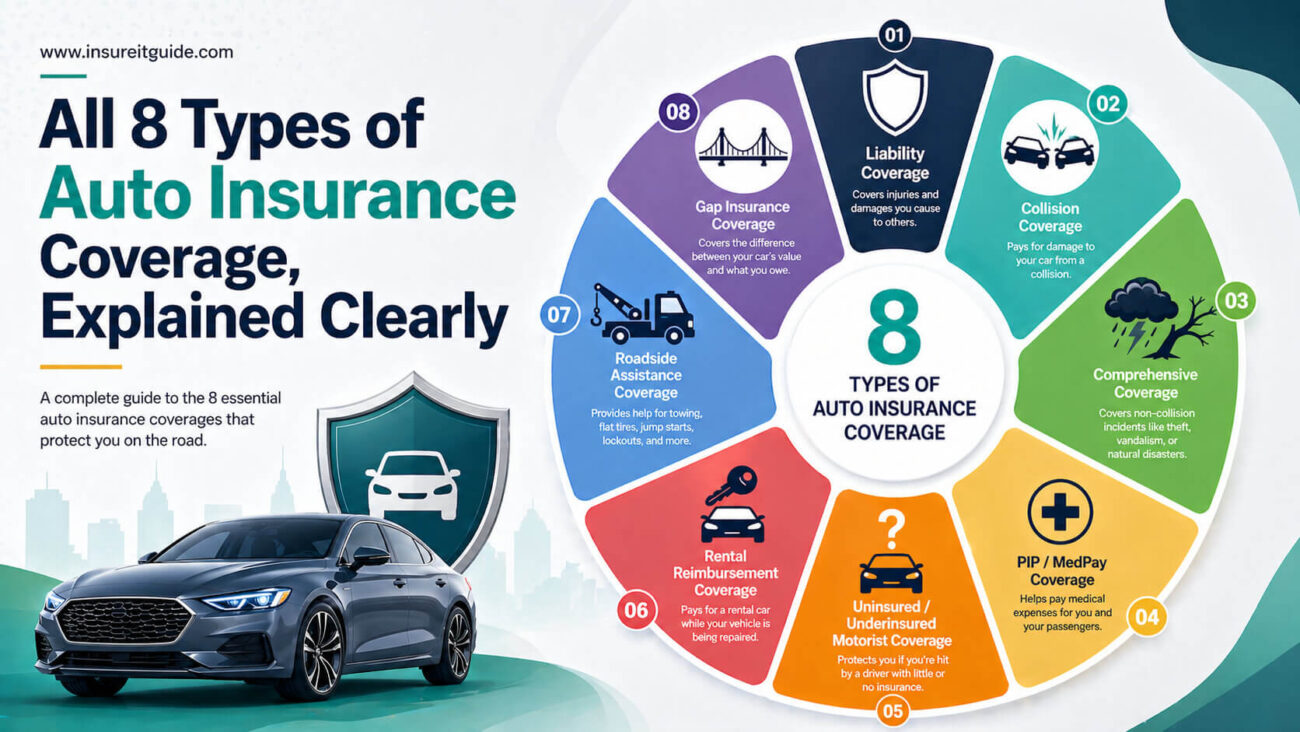
One woman handed me her repair bill after a hit-and-run demolished her car. She had assumed her insurance would cover everything. It didn’t. She carried the state minimum, and she wrote a personal check for $11,400 out of her own pocket. That story is not unusual. It happens every day, to drivers who thought they were covered.
This guide clearly breaks down all 8 types of auto insurance coverage by explaining what each one does, what it doesn’t cover, and when you may need it or, alternatively, when you can skip it. As a result, by the end of this guide, you’ll know exactly how to build a policy that protects you while avoiding unnecessary coverage costs.
COVERAGE #1:
Liability Coverage
Required in almost every U.S. state | Avg. $40 to $90/month
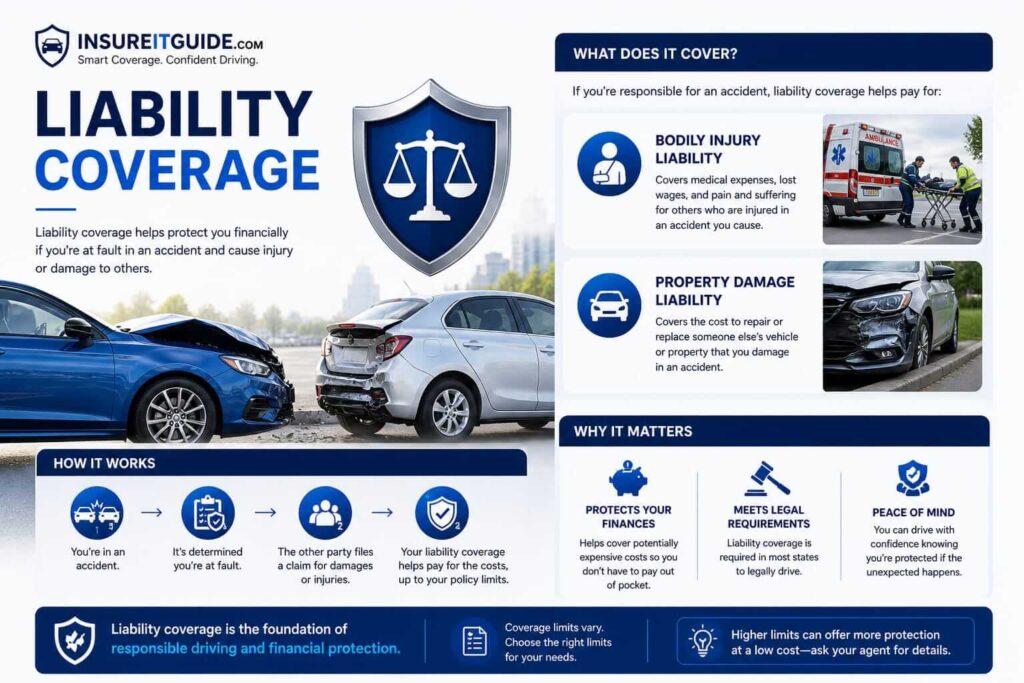
Liability insurance is a legal requirement that nearly every driver misunderstands. It does not protect you or your car; instead, it covers the other person’s damages when you cause an accident.
Liability Insurance has two components:
- Bodily Injury Liability (BI): It pays the other driver’s medical bills, lost wages, and legal fees if they sue you.
- Property Damage Liability (PD): Covers repairs or replacement for the other driver’s vehicle, fence, mailbox, or anything else you damaged.
Limits appear as numbers like 25/50/25, meaning $25,000 per injured person, $50,000 per accident, and $25,000 for property damage. Most states set minimums somewhere in this range.
Why State Minimums Aren’t Enough
REAL CLIENT STORY
A 24-year-old with bare minimum coverage rear-ended a Tesla Model S at a red light. Repair cost: $19,800. His property damage limit: $10,000. He wrote a personal check for $9,800 that same month. State minimums are a legal floor, not a financial safety net.
Upgrading from 25/50/25 to 100/300/100 typically costs only $15 to $30 more per month. That’s a small price for a significant jump in protection. California’s minimum is 15/30/5. Alaska’s is 50/100/25. Check your state’s current requirements through your DMV’s official website.
| Avg. Monthly Cost | Required? | Covers Your Car? | Recommended Limit |
| $40 to $90 | Yes, most states | No | 100/300/100 |
COVERAGE #2:
Collision Coverage
Required if financed or leased | Avg. $40 to $80/month
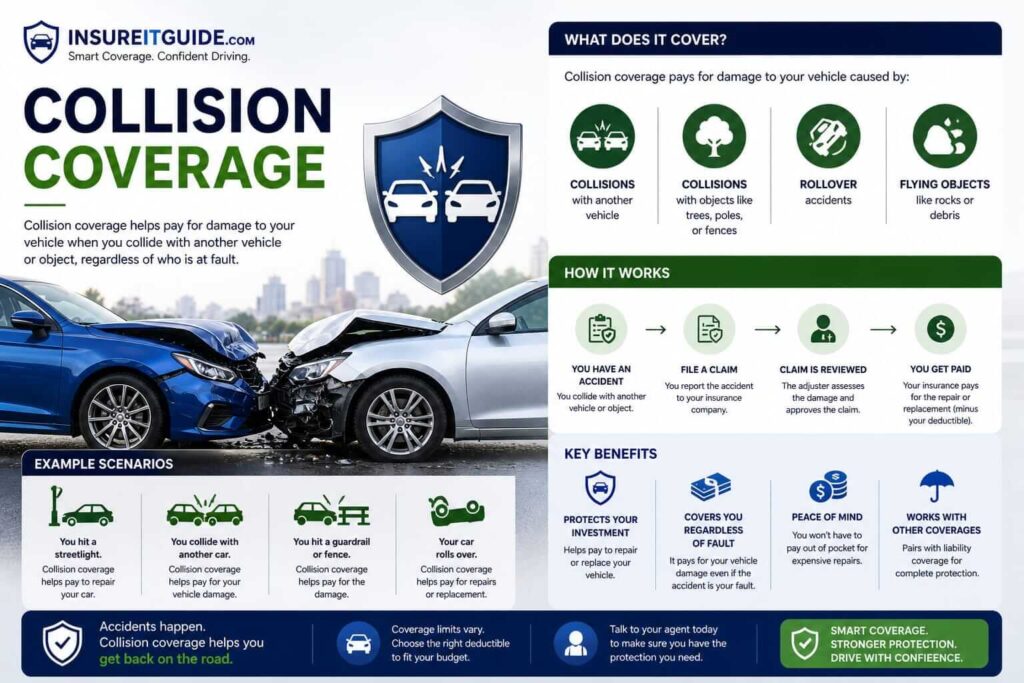
Collision coverage protects your vehicle when liability protects the other driver. It pays to repair or replace your car after an accident, regardless of who was at fault. That includes hitting another vehicle, a guardrail, a utility pole, or rolling your car on a curve.
Every collision policy comes with a deductible. That’s the amount you pay before your insurer covers the rest. Common choices are $250, $500, or $1,000. On a $28,000 vehicle with a $500 deductible, a total loss means your insurer cuts you a check for roughly $27,500, minus depreciation.
When to Skip Collision Entirely
COST-SAVING TIP
Raising your deductible from $250 to $1,000 can cut your collision premium by 25 to 40%. For many drivers, that’s $300 or more saved every year.
If your car is worth less than $4,000, run the math before renewing collision coverage. Your annual premium ($800 to $1,200) plus your deductible ($500 to $1,000) often equals or exceeds what your insurer would actually pay out on a claim. Check your car’s current value at kbb.com before each renewal.
| Avg. Monthly Cost | Required? | Covers Your Car? | Fault Required? |
| $40 to $80 | If financed/leased | Yes | No |
COVERAGE #3:
Comprehensive Coverage
Required if financed or leased | Avg. $15 to $40/month
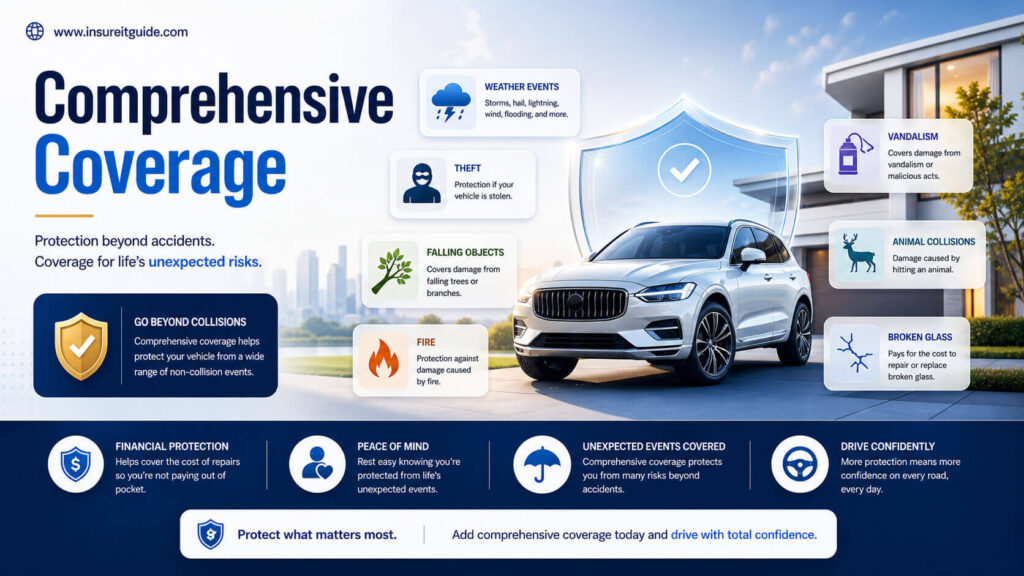
Comprehensive coverage has a misleading name. It doesn’t cover everything. Think of it as the “everything except a collision” category. It covers damage caused by events outside your control.
What’s covered:
- Theft of your vehicle
- Vandalism such as keying or smashed windows
- Fire or explosion
- Flood, hail, tornadoes, and hurricanes
- Falling objects like tree branches or highway debris
- Striking an animal (hitting a deer is a comprehensive claim, not a collision claim)
The $280 Policy That Saved $34,200
REAL CLIENT STORY
In 2023, a client in Texas lost a nearly new truck to flash flooding. Total loss. Comprehensive paid out $34,200. His annual premium had been $280. Without it, he’d have been making loan payments on a truck at the bottom of a ravine.
If you’re financing or leasing, your lender will almost certainly require both collision and comprehensive. If the car is worth financing, it’s worth insuring.
| Avg. Monthly Cost | Required? | Covers Your Car? | Best For |
| $15 to $40 | If financed/leased | Yes | Weather-prone areas |
COVERAGE #4:
Uninsured / Underinsured Motorist Coverage

Required in some states | Avg. $15 to $30/month
Most drivers assume that if someone else causes an accident, that person’s insurance pays. That assumption fails more often than you’d expect.
1 in 8 drivers on American roads carries zero auto insurance. In Mississippi and Michigan, that number climbs to 1 in 4. Uninsured Motorist (UM) coverage pays your bills when a driver with no insurance hits you. Underinsured Motorist (UIM) coverage fills the gap when the at-fault driver’s limits aren’t enough to cover your losses.
What a $40,000 Gap Looks Like
Picture this: you’re in a serious accident. Your medical bills total $65,000. The at-fault driver carries the state minimum of $25,000 in bodily injury coverage. Your UIM policy covers the remaining $40,000. Without it, your only option is suing someone who probably has no assets. That’s a dead end.
UM/UIM coverage comes in two forms:
- UM/UIM Bodily Injury: Covers your medical bills, lost income, and pain and suffering.
- UM/UIM Property Damage: Covers vehicle repairs, often with a $200 to $300 deductible.
Don’t drop this to save $15 a month. In many states, you can stack UM limits across multiple vehicles on your policy, multiplying your protection without multiplying your cost.
| Avg. Monthly Cost | Required? | Who It Protects | Worth It? |
| $15 to $30 | Some states | You and passengers | Almost always |
COVERAGE #5:
Personal Injury Protection (PIP)
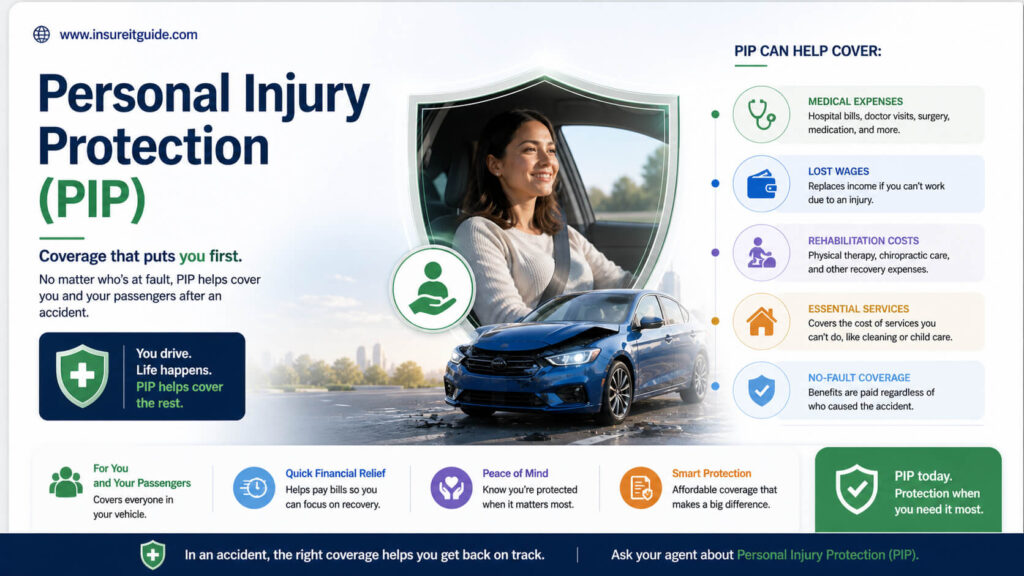
Mandatory in no-fault states | Avg. $20 to $80/month
Personal Injury Protection (PIP) is required in no-fault states including Florida, New York, Michigan, and New Jersey. In a no-fault state, your own insurance covers your medical bills after an accident, regardless of who caused it.
PIP covers far more than hospital bills:
- Your medical costs and your passengers’
- Lost wages if injuries keep you out of work
- Rehabilitation and physical therapy
- Funeral expenses
- Household services you can’t perform while injured, such as childcare or cleaning
How Quickly Minimums Run Out
Florida requires a minimum of $10,000 in PIP. That sounds like solid protection until you spend two days in a hospital. Michigan’s PIP has historically been the most generous in the country, though recent law changes introduced more limit options to help lower premiums.
Even in states where PIP is optional, it’s worth carrying if your health insurance has high deductibles or coverage gaps. A $50,000 PIP limit can add as little as $200 a year to your premium.
| Avg. Monthly Cost | Required? | Covers Lost Wages? | Covers Passengers? |
| $20 to $80 | No-fault states | Yes | Yes |
COVERAGE #6:
Medical Payments Coverage (MedPay)
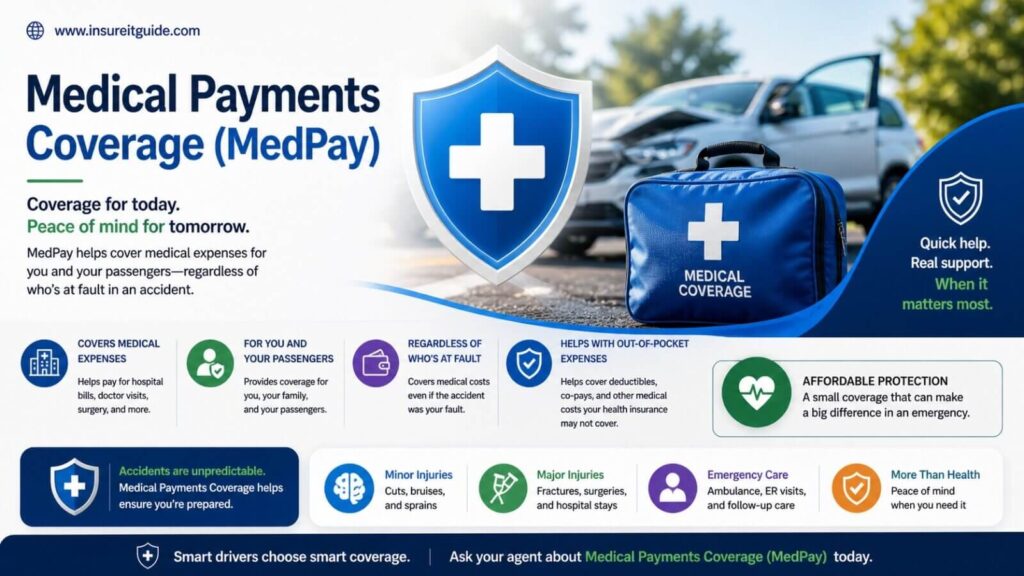
Optional in most states | Avg. $5 to $10/month
MedPay does one thing: it pays medical bills after an accident, with no fault determination required. You file the claim. It pays. That applies to you, your passengers, and in some cases situations where you’re hit as a pedestrian or cyclist.
Who Gets the Most Value From MedPay
MedPay won’t cover lost wages or rehab the way PIP does. What it does is act as fast, simple first-layer medical protection while larger claims work through the system. Limits run from $1,000 to $25,000, and a $5,000 policy can cost as little as $5 to $10 a month.
MedPay makes the most sense for: frequent drivers, people who carpool regularly, anyone with a high-deductible health plan, and drivers in states without PIP requirements.
| Avg. Monthly Cost | Required? | Covers Lost Wages? | Fault Required? |
| $5 to $10 | Rarely | No | No |
COVERAGE #7:
Gap Insurance
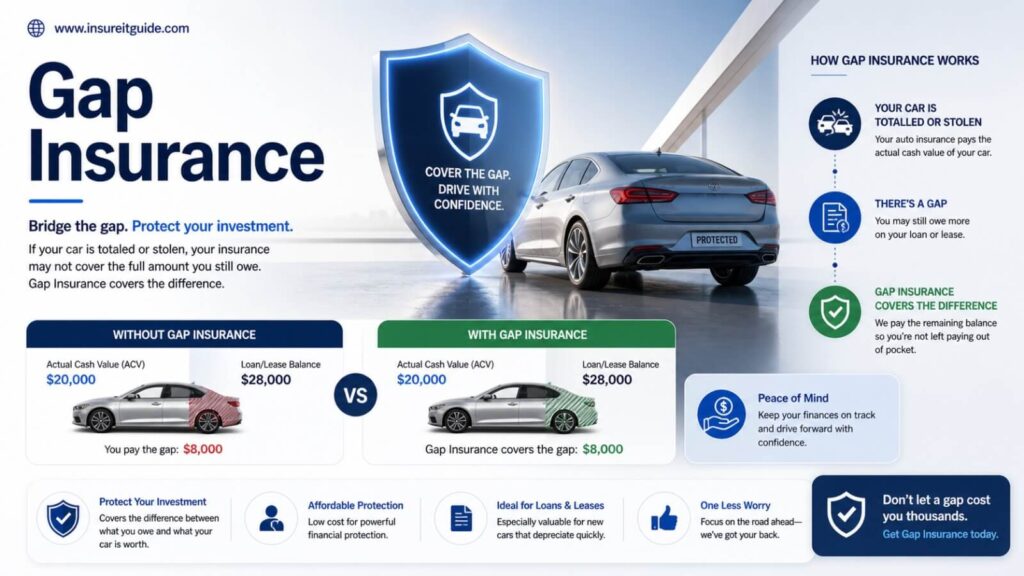
Recommended for new loans | Avg. $3 to $7/month
Gap insurance solves a problem most new car buyers don’t see coming. Vehicles lose value fast. A new $35,000 car can drop $5,000 to $7,000 in value the moment you drive it off the lot. If that car gets totaled six months later, your insurer pays the current market value, say $28,000. But if you owe $33,000 on the loan, you’re personally on the hook for the $5,000 difference. Gap insurance covers that difference.
A Real $5,500 Save
A family I worked with financed a new minivan over 72 months. The car was totaled in month 11. Market value: $26,400. Loan balance: $31,900. Gap insurance covered the full $5,500. Without it, they’d have been paying off a car sitting in a salvage yard.
Gap coverage makes the most sense when you:
- Financed more than 80% of the purchase price
- Chose a loan term of 60 months or longer
- Drive high annual mileage, which speeds up depreciation
- Leased your vehicle (most lease agreements require it)
Don’t Buy It from the Dealership
Dealers charge $500 to $800 for gap coverage and often roll it into your loan, where it collects interest. Your auto insurer will typically offer the same coverage for $20 to $40 a year. Always check your insurer first.
| Avg. Monthly Cost | Required? | Best Period | Loan-to-Value |
| $3 to $7 | Often with leases | First 2 to 3 years | Over 80% |
COVERAGE #8:
Rental Reimbursement Coverage
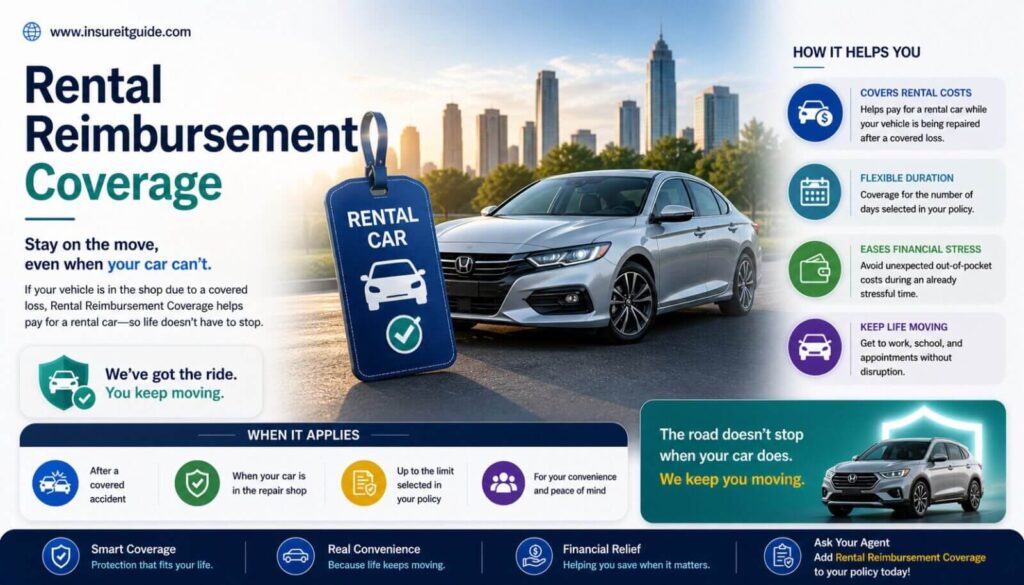
Optional | Avg. $3 to $10/month
Rental reimbursement is easy to overlook and cheap to regret skipping. After an accident, your car may sit in a shop for days or weeks. Rental cars run $40 to $80 per day. That adds up fast.
This coverage pays for a temporary replacement vehicle while your car is in the shop for a covered claim. Limits are expressed as a daily cap and a total maximum, such as $40 per day up to $1,200. Some policies offer $50 or $60 daily options.
One day in a rental costs more than two months of this premium. If you depend on a single vehicle to commute, this is one of the easiest add-ons to justify.
One Important Limit to Know
Rental reimbursement only applies when your car is in the shop for a covered insurance claim. It won’t help if your car breaks down from normal wear, needs routine maintenance, or you just want wheels while traveling. Some credit cards include rental benefits that cover those gaps.
| Avg. Monthly Cost | Required? | Typical Daily Limit | Best For |
| $3 to $10 | No | $40 to $60/day | Single-car households |
All 8 Coverages at a Glance
| Coverage Type | What It Covers | Required? | Avg. Monthly Cost |
| Liability | Other driver’s injuries and property damage | Yes (most states) | $40 to $90 |
| Collision | Your car in at-fault and no-fault crashes | If financed/leased | $40 to $80 |
| Comprehensive | Theft, weather, animals, fire, falling objects | If financed/leased | $15 to $40 |
| UM / UIM | Accidents with uninsured or underinsured drivers | Some states | $15 to $30 |
| PIP | Your medical bills, lost wages, rehabilitation | No-fault states | $20 to $80 |
| MedPay | Basic medical bills after an accident | Rarely | $5 to $10 |
| Gap Insurance | Loan balance if car is totaled | Often with leases | $3 to $7 |
| Rental Reimbursement | Rental car while yours is being repaired | No | $3 to $10 |
Note: Figures represent national averages. Your actual premium depends on your driving history, location, age, credit score, and vehicle type. Get quotes from at least three insurers at every renewal. Rates for identical coverage can differ by as much as 40%.
How to Build Your Coverage Stack
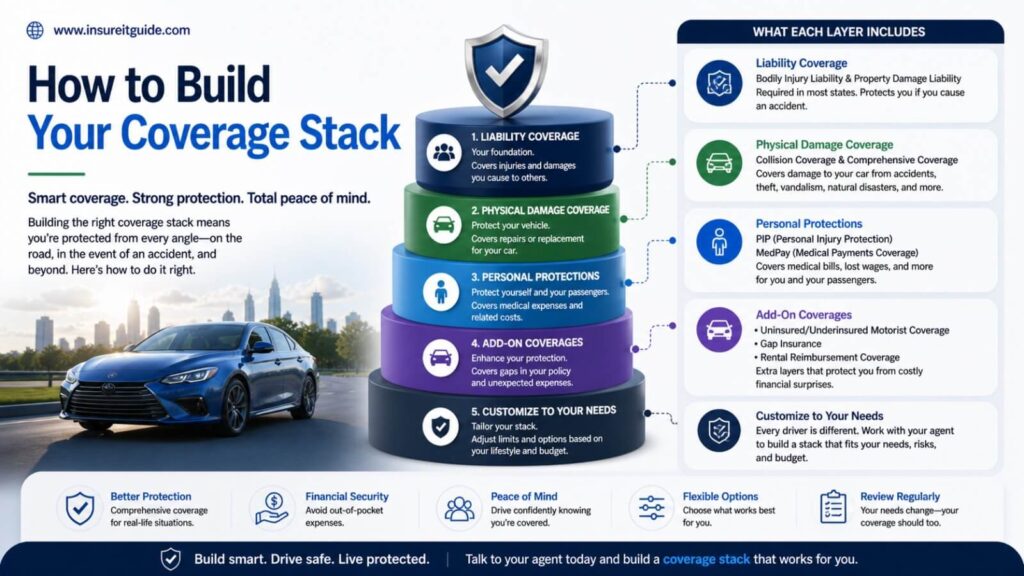
Your coverage needs depend on your situation. A 22-year-old with a paid-off older car needs a very different policy than a 40-year-old financing a new SUV with kids in the back seat. Here’s a practical framework that works for both.
For Drivers with Older, Low-Value Vehicles (Under $6,000)
| Coverage | Recommendation |
| Liability | 100/300/100. Always exceed the state minimum. |
| UM / UIM Bodily Injury | Match your liability limits. |
| MedPay | $5,000 to $10,000. |
| Collision / Comprehensive | Consider skipping. Run the math on your car’s value first. |
| Rental Reimbursement | Optional, but worth it if you depend on one vehicle. |
For Drivers Financing or Leasing a Newer Vehicle
| Coverage | Recommendation |
| Liability | 100/300/100 minimum. Consider 250/500/100 if you have significant assets. |
| Collision | Required by lender. Set deductible at $500 to $1,000 to manage premiums. |
| Comprehensive | Required by lender. Match your collision deductible. |
| Gap Insurance | Strongly recommended for the first 2 to 3 years of the loan. |
| UM / UIM | Carry both bodily injury and property damage. |
| PIP or MedPay | Depends on your state and your health insurance situation. |
| Rental Reimbursement | $3 to $10 a month. A clear yes for single-car households. |
A solid, well-rounded policy for a financed vehicle typically runs $120 to $200 per month. That cost varies with your age, driving record, location, and credit score. For what it protects, most drivers find it more than justified.
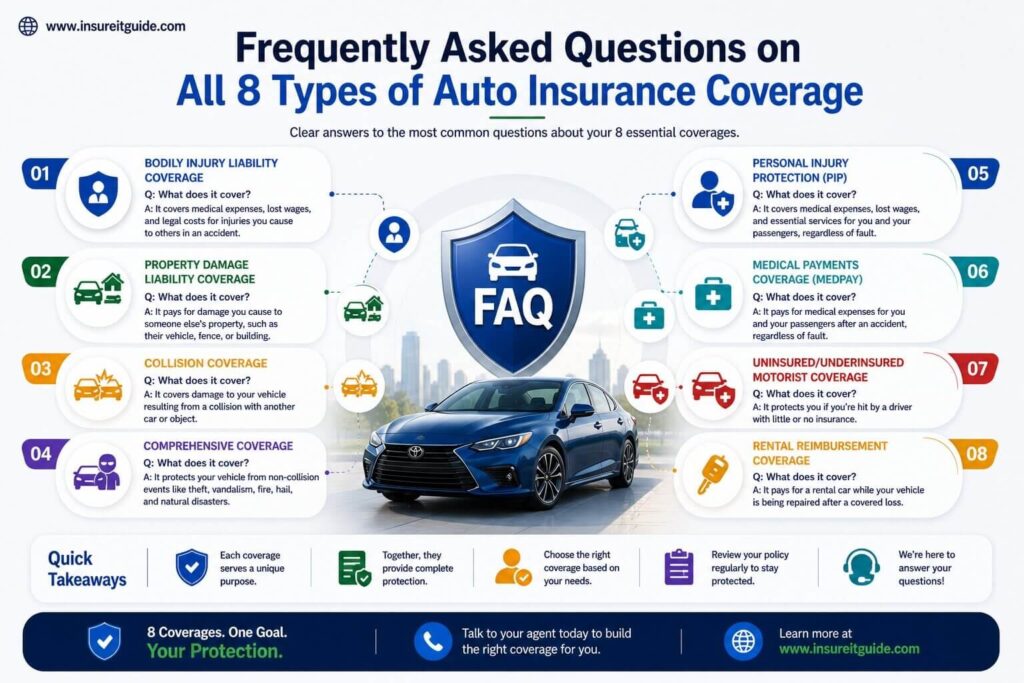
Frequently Asked Questions
What are the most important types of auto insurance?
Liability is the non-negotiable starting point. It’s legally required in nearly every state and your primary shield against financial ruin if you injure someone. From there, collision and comprehensive protect your vehicle (required if you’re financing or leasing), and UM/UIM protects you from the very real risk of an uninsured driver. Those four form a solid core.
What does auto insurance not cover?
Standard policies don’t cover mechanical breakdowns, routine maintenance, or personal belongings stolen from inside your car. That last one falls under homeowners or renters insurance. Rideshare drivers face a specific gap too: personal policies typically exclude coverage during active ride periods. You’ll need a rideshare endorsement to fill that hole.
Is “full coverage” worth it?
“Full coverage” isn’t a real product. It’s shorthand for liability plus collision plus comprehensive. Whether it’s worth it depends on your car’s value and your loan. For newer or financed vehicles, yes. For paid-off cars worth less than $5,000 to $6,000, run the numbers first and let the math decide.
How can I lower my auto insurance premium?
Several approaches consistently work:
- Raise your deductible. That alone cuts collision and comprehensive premiums by 25 to 40%.
- Bundle your auto and home policies for a typical 10 to 25% discount.
- Ask about every available discount: good driver, good student, low mileage, anti-theft device.
- Shop quotes every year instead of auto-renewing.
- Look into usage-based insurance if you drive fewer than 10,000 miles a year.
What’s the difference between PIP and MedPay?
Both pay your medical bills after an accident without requiring a fault determination. PIP goes further by also replacing lost wages and covering services you can’t perform while injured, like childcare. MedPay handles medical bills only. PIP is mandatory in no-fault states. MedPay is a supplemental add-on available in most other states.
Do I need gap insurance on a used car?
Probably not. Gap insurance is most valuable when a large difference exists between what you owe and what the car is worth. That gap is biggest with new vehicles in the first one to three years of ownership. If you put a solid down payment on a used car or chose a short loan term, your balance and your car’s value are likely close enough that gap coverage isn’t worth the cost.
What happens if an uninsured driver hits me?
With UM coverage, your own insurer handles it. You file the claim, your policy pays your medical bills and potentially your vehicle repairs, and your insurer may pursue the at-fault driver directly. Without UM coverage, your only option is a civil lawsuit. If that driver has no insurance, they almost certainly have no assets either. It’s a path that rarely leads anywhere.
Final Thoughts
Auto insurance isn’t exciting. Nobody enjoys thinking about it. But after more than a decade working through real accidents, totaled cars, and serious financial hardship with real clients, I’ve seen exactly what the right coverage does for people, and what the wrong coverage costs them.
The woman who wrote an $11,400 check because she had no collision coverage. The family whose gap insurance saved them $5,500. The driver who never paid a single medical bill after an uninsured motorist hit him, because he carried UM coverage. None of those outcomes happened at the time of the accident. They were decided months or years earlier, at renewal time, when those drivers chose what to buy and what to skip.
Buy what protects you. Skip what doesn’t fit your situation. And check your policy every year, because your life changes, and your coverage should keep up.
InsureItGuide.com · Your Independent Resource for Insurance Education & Savings · Updated April 2026
